The core advantage of vacuum circuit breakers lies in the interrupting medium—vacuum itself—which offers zero carbon emissions, strong interrupting capability, long electrical life, and maintenance-free operation. In the medium voltage range (12kV–40.5kV), VCBs have long been the dominant solution. However, at higher voltage levels (72.5kV and above), SF₆ circuit breakers have maintained their leading position due to their excellent insulation performance. Since SF₆ has an extremely high Global Warming Potential (approximately 23,900 times that of CO₂), its use faces increasingly stringent international regulations and carbon constraints.
This background provides a clear technical impetus for extending vacuum circuit breaker technology into high-voltage transmission applications. Current mainstream technical development directions include: increasing the withstand voltage capability of single-break vacuum interrupters, applying multi-break series technology at 126kV and above, and hybrid solutions combining eco-friendly gas insulation with vacuum interruption.
| Interruption Medium | GWP (CO₂e) | Interrupting Capability | Contains Fluorine | Environmental Trend |
|---|---|---|---|---|
| Vacuum | 0 | Excellent (mature at MV, under validation at HV) | No | Preferred path |
| SF₆ | ~23,900 | Excellent (mature at all voltage levels) | Yes | Facing strict restrictions |
| Eco-friendly gases (C4/C5, etc.) | ~300–1,000 | Medium-High (requires vacuum interruption) | Yes (but far lower than SF₆) | Transitional solution |
Applying vacuum circuit breakers to transmission voltage levels requires overcoming several key technical challenges.
First, the insulation capability of vacuum interrupters. As voltage levels increase, the pre-strike characteristics of the vacuum gap, contact surface condition, and electric field uniformity have a significantly amplified impact on insulation performance. Common technical approaches include optimizing contact structures (such as axial magnetic field contacts), improving the vacuum level of the interrupter, and employing composite insulation structures.
Second, high-speed response of the operating mechanism. High-voltage vacuum circuit breakers typically require shorter total interrupting times, placing higher demands on the mechanical characteristics of the operating mechanism. Spring mechanisms, permanent magnetic actuators, and electromagnetic repulsion mechanisms each have their own advantages and disadvantages in terms of fast opening, initial opening speed, and dispersion control.
Third, voltage sharing in multi-break series connections. At voltage levels of 126kV and above, the technical difficulty and cost of single-break vacuum interrupters increase significantly, making multi-break series connection a practical engineering option. However, multi-break series connections face challenges with both static and dynamic voltage distribution imbalances, requiring solutions such as grading capacitors or synchronous control technology.
According to publicly available industry information, several domestic and international switchgear manufacturers and research institutions have completed prototype development at the 126kV level and have entered the engineering validation phase. This progress is regarded within the industry as a substantial step toward extending vacuum switching technology into high-voltage applications.
| Voltage Level | Typical Applications | Main Interrupter Structure | Operating Mechanism Type | Intelligence Level |
|---|---|---|---|---|
| 12kV | Distribution networks, industrial/commercial facilities, residential substations | Single-break | Spring/Permanent magnet | High (成熟的) |
| 24kV | Industrial distribution, mining, railways | Single-break | Spring/Permanent magnet | Medium-high |
| 40.5kV | Wind power, metallurgy, substation feeders | Single-break (high capacitance) | Spring/Electromagnetic | Medium-high |
| 72.5kV | HV transmission/distribution, grid interconnections | Multi-break series | Spring/Hydraulic | Medium |
| 126kV and above | Main transmission grids, UHV lower-voltage side | Multi-break/Hybrid | High-speed mechanism | Low to High (under development) |
Within the framework of distribution automation and intelligent operation/maintenance systems, vacuum circuit breakers are being赋予 a new role. Traditional VCBs focus on fault isolation and line protection. The new generation of primary-secondary integrated VCBs deeply integrates current/voltage sensing, power harvesting, condition monitoring, communication, and protection control functions.
Specifically, industry technical consensus includes: compact integrated design of electronic instrument transformers with the vacuum interrupter; the controller's ability to rapidly identify and clear short-circuit faults (typically within a few cycles); support for fast auto-reclosing; and fault recording and remote communication capabilities.
Furthermore, with the increasing demand for renewable energy grid integration, the requirement for VCBs to interrupt high DC components is also rising. Short-circuit currents on the solar, wind, and energy storage system side often contain a significant proportion of DC components, posing technical challenges beyond those of traditional AC systems.
| Function Module | Specific Content | Technical Requirements |
|---|---|---|
| Current/Voltage Sensing | Electronic instrument transformers (LPCT/EVT) | Measurement accuracy, anti-saturation capability |
| Power Harvesting | CT power harvesting + backup battery/supercapacitor | Low startup current, long backup time |
| Protection Control | Overcurrent, short-circuit, zero-sequence, reclosing | Fast identification and clearing |
| Condition Monitoring | Mechanical characteristics, temperature rise, insulation status | Online monitoring and trend warning |
| Communication Interface | RS485/Ethernet/fiber optic, Modbus/IEC 61850 | Data synchronization, telecontrol protocol compatibility |
| Integration Level | Typical Characteristics | Main Application Scenarios |
|---|---|---|
| Traditional | Switchgear本体 separate from protection device | Retrofitting old substations, cost-sensitive projects |
| Semi-integrated | Electronic controller integrated with switchgear, external signal connection | Conventional distribution automation |
| Deeply integrated | Sensors built into interrupter/pole,一体化设计 | Smart distribution grids, digital substations |
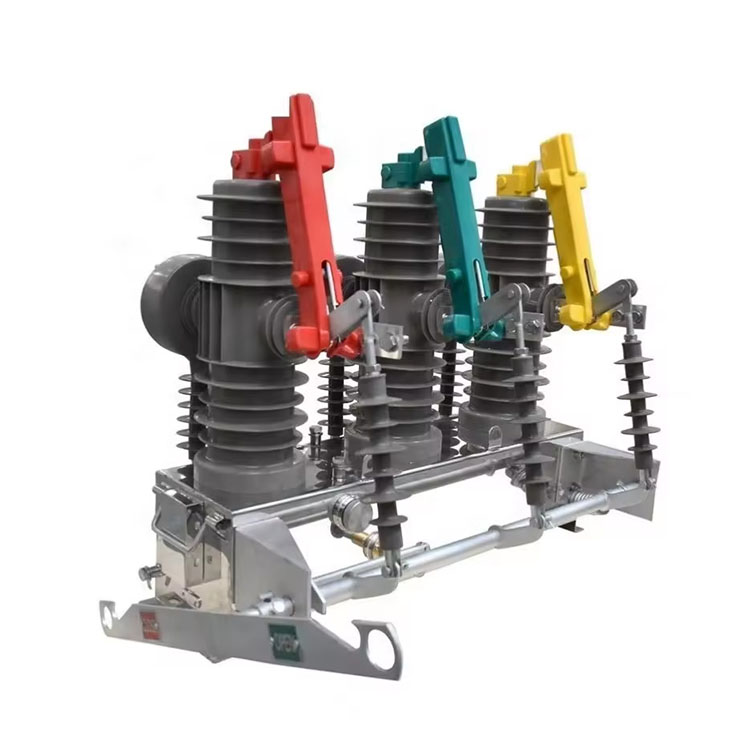
Outdoor pole-mounted vacuum circuit breakers operate in complex and variable environments. Moisture, condensation, salt fog, extreme temperatures, and dust are common causes of equipment failure. Among these, insulation degradation and mechanism corrosion caused by condensation are the most prominent issues.
Addressing this pain point, increasing the overall ingress protection (IP) rating has become a major technical upgrade direction for outdoor VCBs in recent years. Industry-leading practices have raised protection ratings from traditional IP54 to IP67 or even IP68. IP67 means the equipment can withstand temporary immersion in water without damage, while IP68 signifies the ability to operate while continuously submerged under specified conditions.
Key technologies for achieving high IP ratings include: sealing interface design between the interrupter and mechanism housing, corrosion-resistant treatment of the operating mechanism, and optimization of sealing structures between bushing insulators and the housing.
| IP Rating | Dust Protection | Water Protection | Typical Application Environment | Maintenance-Free Cycle |
|---|---|---|---|---|
| IP54 | Limited dust protection | Protected against splashing water | Dry inland, indoor/outdoor general | ~1 year |
| IP65 | Dust-tight | Protected against water jets | General outdoor, sandy areas | 2–3 years |
| IP67 | Dust-tight | Temporary immersion (30 min/1m) | Coastal, high-humidity/rainy areas | 3–4 years |
| IP68 | Dust-tight | Continuous immersion (specified conditions) | Flood-prone areas, underground utility tunnels |