News

Box-Type Substations: What They Are, How They Work, and Where They Are Used

2026-09-24 0 Leave me a message

1. What Is a Box-Type Substation?

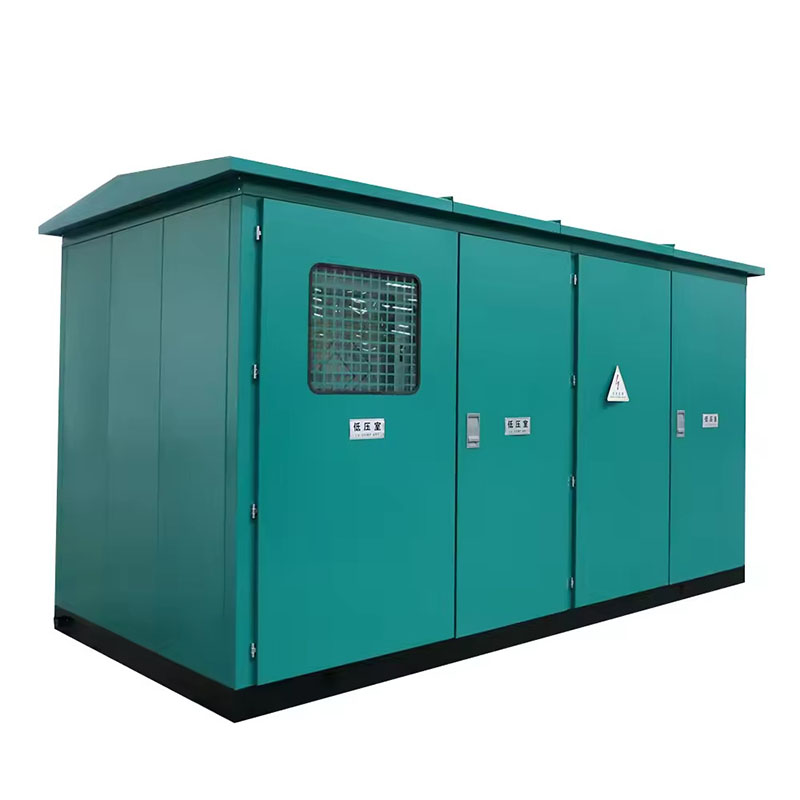
A box-type substation is a prefabricated, type-tested assembly: one enclosure containing medium-voltage switchgear, a distribution transformer, low-voltage distribution equipment, and the connections and auxiliary devices that tie them together.

The definition is not a marketing one. It comes from the international standard for the equipment class, IEC 62271-202, which covers prefabricated substations cable-connected to AC high-voltage networks at operating voltages up to and including 52 kV. In China the corresponding standard is GB/T 17467.

The operative word is “prefabricated”. A conventional substation is a building: civil works, a room for the switchgear, a separate transformer bay, a low-voltage room, and a construction programme measured in months. A box-type substation is assembled and tested at the factory, shipped as a unit, set down on a prepared foundation and connected. The building work is replaced by a foundation and a cable trench.


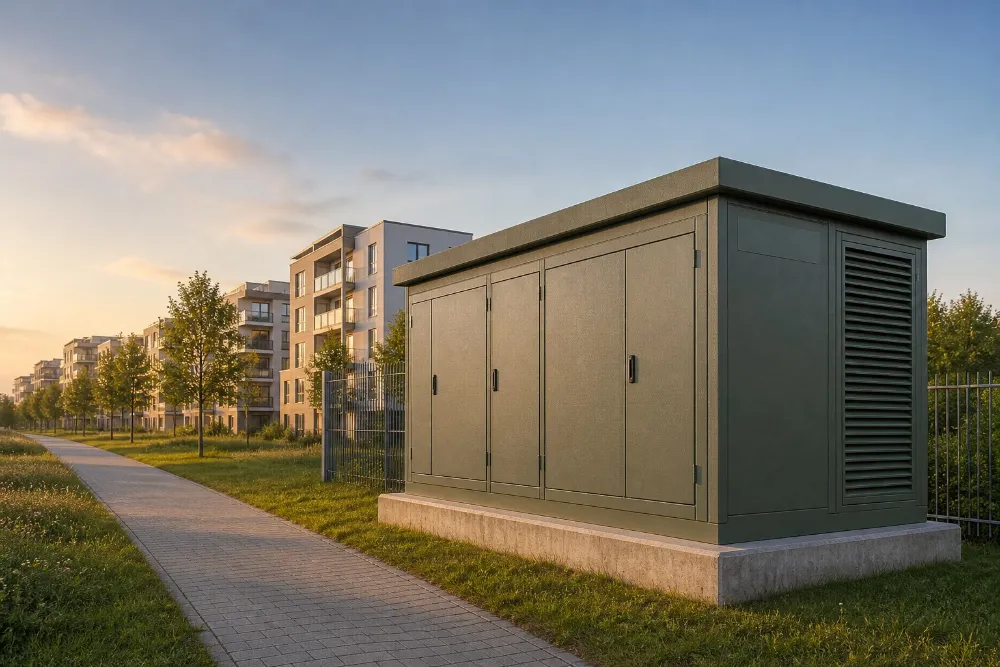
Figure 01 (illustration)  A box-type substation installed at the edge of a residential district — close to the load it serves, without a substation building.

2. Inside the Box: Three Compartments in One Enclosure

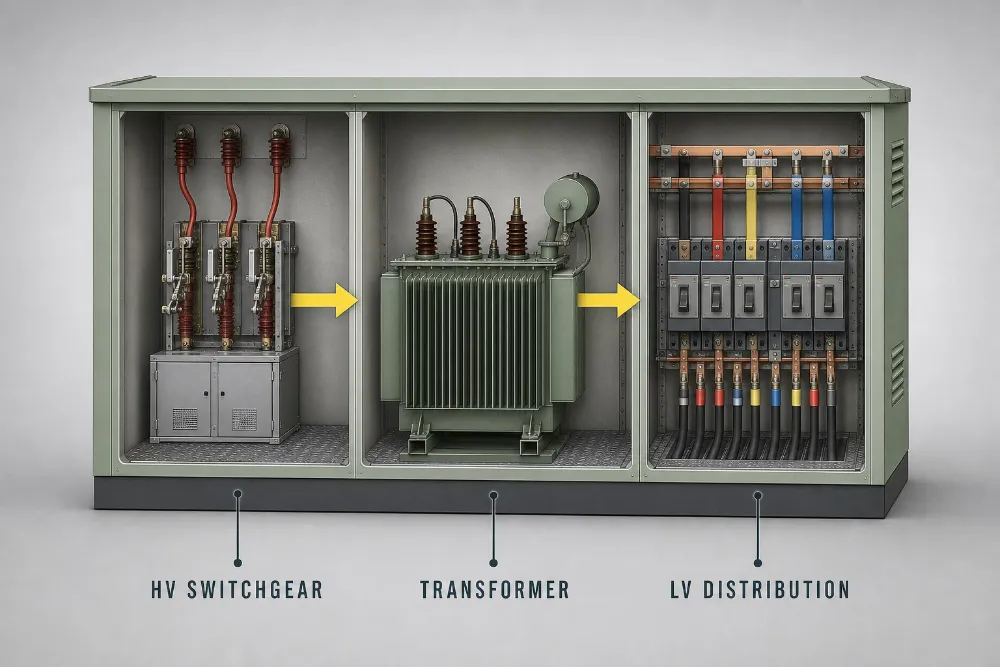
Open the doors and the enclosure divides into three functional zones, laid out along its length:

• High-voltage switchgear — the incoming side. This is where the cable from the network terminates, and where switching, isolation and protection for the transformer begin.

• The transformer — the heart of the unit. It steps medium voltage down to the low voltage the loads actually use, and it is the component that sets the substation’s capacity.

• Low-voltage distribution — the outgoing side. The stepped-down supply is split across outgoing circuits, each with its own protection, metering and switching.

The three functions are the same in every box substation. What changes between designs is how they are arranged — and that one decision drives footprint, cost and serviceability.


Figure 02 (illustration)  The three functional compartments in a box-type substation: high-voltage switchgear, transformer and low-voltage distribution.

3. American-Style, European-Style, and the Middle Ground

Two design philosophies have dominated, and the difference is about arrangement rather than function.

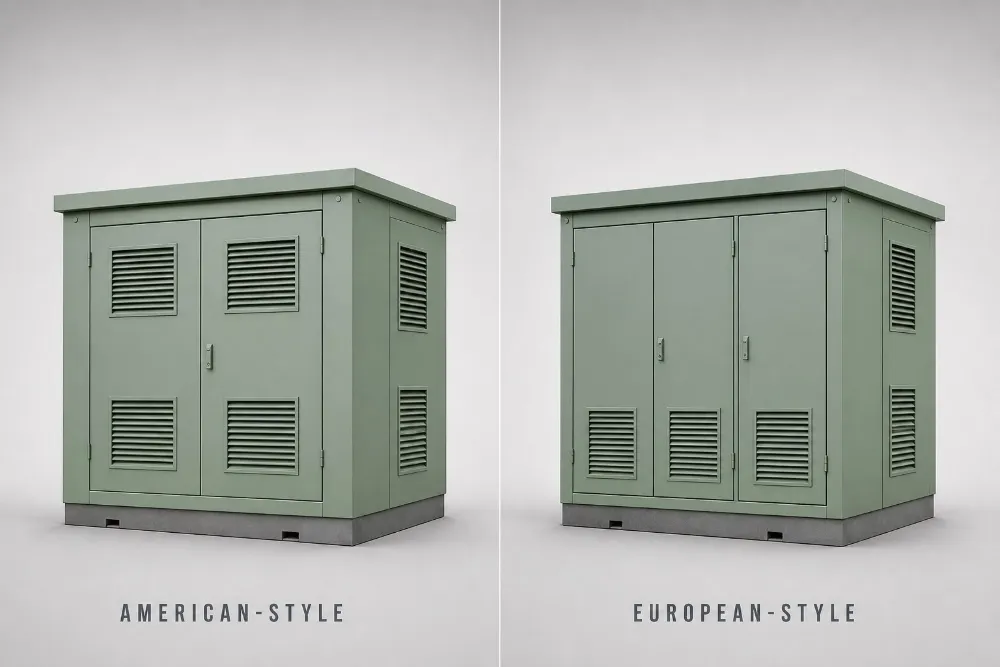
The European-style design places the three functions in three separate compartments, connected to each other by cable or busbar, with the layout typically described as “目”-shaped or “品”-shaped. This gives clear functional zoning and straightforward maintenance access, at the cost of a larger footprint. The approach was introduced into China from France and Germany from the late 1970s.

The American-style design is built around an oil-immersed transformer, with the high-voltage side protected by fuses against short-circuit and overload conditions. Folding the switching function into the transformer tank makes the unit markedly more compact — which is precisely what a restricted site needs.

A third approach has since emerged to sit between them. The Chinese-style box substation aims for a middle position: more compact and lower in cost than the European-style arrangement, but easier to maintain than the American-style unit. It has become common on wind farms, particularly in the 35 kV compact prefabricated format.

Which one suits a project depends on the site rather than on preference: the footprint available, the maintenance regime the owner can support, the ambient conditions the unit will live in, and how much civil work the project is trying to avoid.


Figure 03 (illustration)  Two design approaches to the same three functions — compartmentalised construction on the left, an integrated compact unit on the right.

4. Where Box Substations Are Used

Their range comes from a simple property: they are equipment, not buildings. That makes them the natural choice wherever a substation is needed but a substation building is not practical.

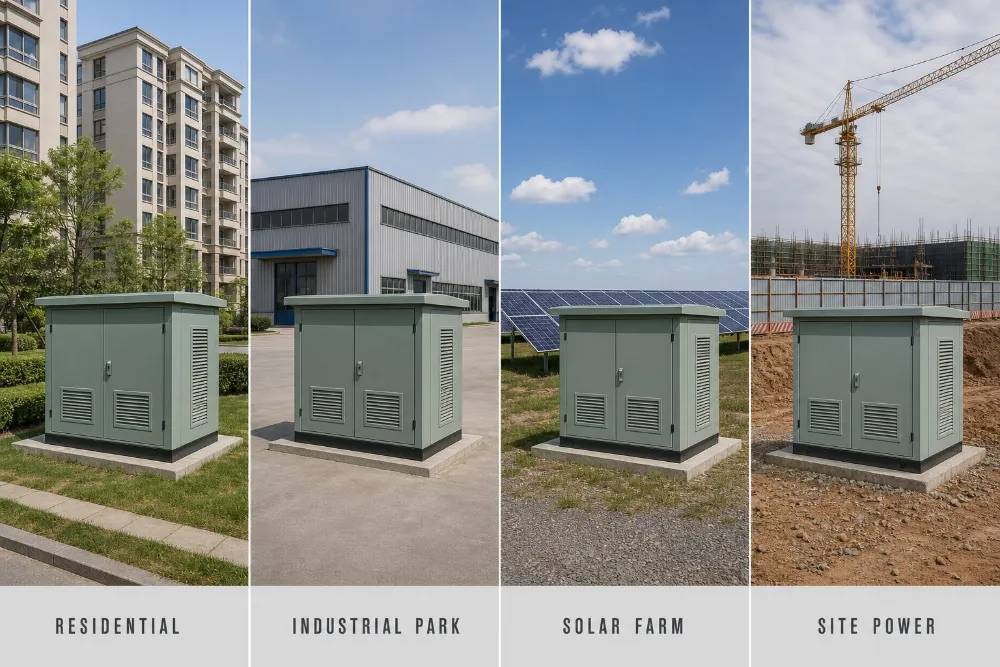
• Residential districts. Placed inside the development, close to the load, where a conventional substation would need land and planning approval it is unlikely to get.

• Industrial parks and factories. Beside the plant they serve, sized to the load and expandable as production grows.

• Solar and wind farms. At the point of collection, where sites are large, remote, and often difficult to build on.

• Construction sites and temporary power. Set down, connected, and later moved on to the next location.


Figure 04 (illustration)  Four common settings: residential, industrial park, solar farm and construction site power.

5. What the Box Actually Delivers

A box-type substation is not simply a smaller building. It changes the shape of the project.

• Time. Factory assembly and type testing happen before the site is ready, so site work shrinks to foundation, cabling and connection.

• Land. The footprint of a compact unit is a fraction of that of an equivalent substation building.

• Predictability. Because the unit is assembled and tested under factory conditions rather than on site, quality does not depend on the weather or on which crew turned up.

• Mobility. Where the load moves, the substation can move with it.

6. From Workshop to Site: How Zikai Builds and Ships Box Substations

Everything above is true of the category. The rest is what it looks like in practice.

Every unit is built to the project rather than taken off a shelf: the enclosure, compartment layout, transformer rating, protection scheme and outgoing circuits are all fixed before production begins. Assembly happens in the workshop, where the enclosure, the compartments and the internal connections can be built and inspected under controlled conditions — which is the entire point of a prefabricated substation.

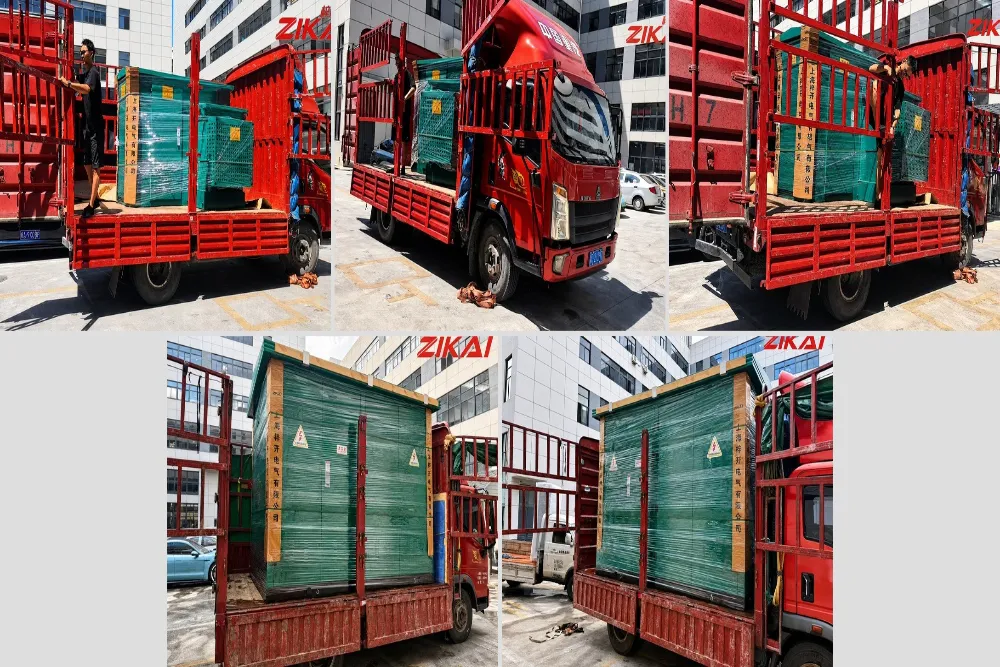
Then comes the stage that decides whether any of it arrives intact. Box substations are large, heavy and awkwardly shaped. They travel on flatbeds, over roads that were not designed for them, and they arrive at sites where unloading equipment may be limited. So every unit is wrapped, battened and braced as a load, stacked in a planned sequence, and checked against the packing list before the truck is closed.

The photographs below show that stage: units wrapped and timber-battened on the vehicle, identified, counted and secured as a single consignment. It is not the most photogenic part of the job. It is the part that determines whether the equipment standing on site is the equipment that left the factory.


Figure 05  Packing and dispatch at the Zikai workshop: box substation units wrapped, battened, identified and loaded as one secured consignment.

7. About Zikai Electric

Zikai Electric (ZIKAI) manufactures, retrofits and services complete power equipment packages, covering box-type substations, high-voltage switchgear, pole-mounted and outdoor vacuum circuit breakers, capacitor compensation devices and associated distribution equipment. Box substations are built to order — to the site’s footprint, the load it has to carry, and the conditions the unit will actually live in.

Editor’s note — Figures 01 to 04 are AI-generated illustrations used to explain the equipment type; they are not photographs of specific ZIKAI installations. Figure 05 is a photographic record of a real packing and dispatch operation. This draft deliberately contains no capacity ratings, dimensions, prices, project dates or client names, none of which were supplied. Confirm the standard references (IEC 62271-202, GB/T 17467) against your own certification before publishing.

Related News
Leave me a message
X
We use cookies to offer you a better browsing experience, analyze site traffic and personalize content. By using this site, you agree to our use of cookies. Privacy Policy
RejectAccept